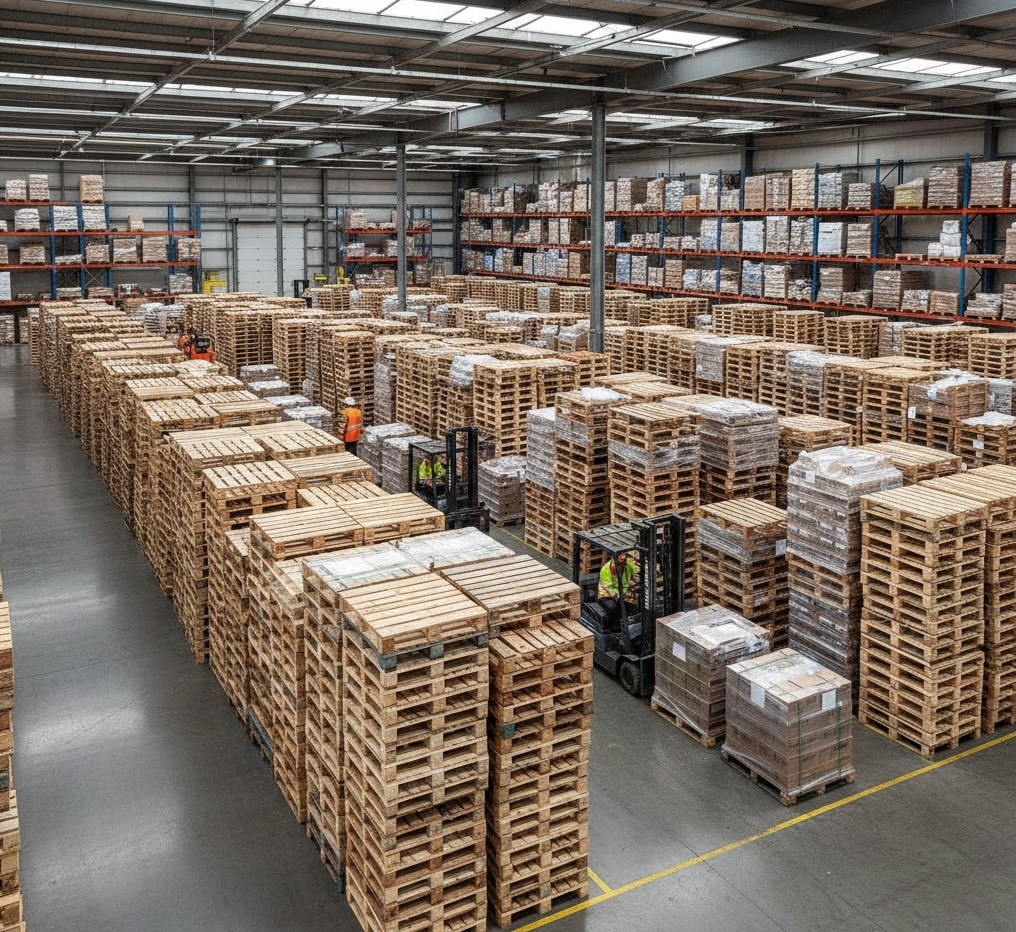
Complete Pallet Size Guide
Comprehensive guide to standard and custom pallet dimensions. Find the perfect size for your industry, understand international standards, and learn how to optimize your supply chain with the right pallet dimensions.
Why Pallet Size Matters
Selecting the correct pallet size impacts your entire supply chain, from warehouse efficiency to shipping costs. Understanding standard sizes helps you optimize operations and reduce expenses.
Cost Efficiency
Standard sizes maximize trailer space, reducing shipping costs by up to 25%. Proper sizing eliminates wasted space and reduces per-unit transportation expenses.
Warehouse Optimization
Correct pallet dimensions ensure perfect fit in racking systems, maximizing vertical storage and improving warehouse density by 15-30%.
Loading Efficiency
Standard sizes enable faster loading and unloading, reducing dock time by 40% and improving overall supply chain velocity.
Global Compatibility
Understanding international standards ensures smooth cross-border shipping and reduces delays at customs and distribution centers.
Product Protection
Properly sized pallets prevent overhang, reduce product damage, and ensure stable loads during transport and storage.
Sustainability
Optimized pallet sizes reduce material waste, lower carbon footprint, and improve recyclability at end of life.
Standard North American Pallet Sizes
North America uses several standard pallet sizes, each optimized for specific industries and applications. Understanding these standards helps you make informed decisions for your operations.
| Size Name | Dimensions (L × W) | Primary Industry | Static Load | Dynamic Load |
|---|---|---|---|---|
GMA Pallet The most common pallet in North America, used by 30% of all businesses | 48" × 40" | Grocery, Retail, Consumer Goods | 5,500 lbs | 4,600 lbs |
CHEP Pallet (Blue) Standardized rental pallet system used globally | 48" × 40" | Pooling System, Retail | 4,400 lbs | 2,800 lbs |
Euro Pallet (EPAL) Required for many European imports/exports | 47.2" × 39.4" | European Standard, Export | 5,500 lbs | 4,400 lbs |
Half Pallet Perfect for retail displays and smaller shipments | 48" × 20" | Retail Display, Small Loads | 3,000 lbs | 2,000 lbs |
Quarter Pallet Ideal for end-cap displays and promotional items | 24" × 20" | Retail, Small Products | 1,500 lbs | 1,000 lbs |
Drum Pallet Square design accommodates four 55-gallon drums | 42" × 42" | Chemical, Petroleum, Drums | 4,500 lbs | 3,000 lbs |
Automotive Pallet Wider design for automotive industry standards | 48" × 45" | Automotive Parts | 4,600 lbs | 3,500 lbs |
Beverage Pallet Square design perfect for beverage industry | 36" × 36" | Beverages, Bottling | 4,200 lbs | 3,000 lbs |
Pharmaceutical Clean room compatible, strict quality standards | 40" × 48" | Pharma, Medical Supplies | 3,800 lbs | 2,500 lbs |
Telecommunications Large square format for heavy equipment | 48" × 48" | Telecom Equipment | 4,000 lbs | 3,000 lbs |
Dairy Pallet Standard in dairy industry for milk crates | 40" × 40" | Dairy Products | 3,500 lbs | 2,800 lbs |
Cement Block Heavy-duty for construction materials | 40" × 48" | Construction Materials | 6,000 lbs | 4,000 lbs |
Understanding Load Capacities:
International Pallet Size Standards
Different regions have adopted different standard sizes based on local industry needs, shipping containers, and historical practices. Understanding these variations is crucial for international trade.
North America
🇺🇸Europe
🇪🇺Australia
🇦🇺Asia
🌏ISO Standard 1
🌍ISO Standard 2
🌍Exporting Internationally?
We offer ISPM 15 certified pallets in all international standard sizes, ensuring your shipments meet global requirements and avoid costly delays at customs.
Learn About Export PalletsNeed Help Choosing a Size?
Our pallet experts can help you select the perfect size for your specific needs. Get a free consultation and quote today.
How to Select the Right Pallet Size
Choosing the correct pallet size requires careful consideration of multiple factors. Follow this comprehensive guide to make the best decision for your operations.
Measure Your Products
Start by measuring your actual products and packaging
- ✓Measure length, width, and height of individual products
- ✓Account for packaging materials and overhang
- ✓Consider how products will be stacked or arranged
- ✓Calculate total footprint needed per pallet
- ✓Allow 1-2 inches clearance on all sides for stability
Consider Your Transport Method
Different transportation modes favor different pallet sizes
- ✓Truck: 48" × 40" pallets fit perfectly in 48-foot trailers (24 per layer)
- ✓Container: 40" × 48" can fit more pallets in 20-foot containers
- ✓Rail: Standard sizes work best for intermodal shipping
- ✓Air freight: Smaller, lighter pallets reduce costs
- ✓Calculate pallets per load to maximize trailer/container utilization
Check Your Warehouse Infrastructure
Ensure pallets fit your existing storage systems
- ✓Measure rack bay widths and depths
- ✓Check forklift capacity and mast height
- ✓Verify aisle widths accommodate pallet dimensions
- ✓Consider how pallets will be accessed (front, side, or both)
- ✓Account for clearances required by fire codes
Calculate Weight and Load Distribution
Match pallet strength to your load requirements
- ✓Calculate total weight including product and packaging
- ✓Determine if load will be stored (static) or moved (dynamic)
- ✓Consider racking load if storing pallets on shelves
- ✓Account for load distribution - concentrated vs. evenly distributed
- ✓Add safety margin of 20-30% to maximum expected weight
Review Industry Standards
Some industries require specific pallet sizes
- ✓Grocery (GMA): 48" × 40" is virtually mandatory
- ✓Automotive: 48" × 45" is industry standard
- ✓Pharmaceuticals: Strict cleanliness and size requirements
- ✓Export: Must comply with destination country standards
- ✓Check with major customers for any specific requirements
Evaluate Total Cost of Ownership
Consider all costs, not just initial purchase price
- ✓Purchase price: Standard sizes are usually cheaper
- ✓Shipping costs: Maximize loads to reduce per-unit shipping
- ✓Storage costs: Higher density reduces warehouse needs
- ✓Handling costs: Standard sizes are faster to load/unload
- ✓Resale value: Standard pallets have better secondary markets
Load Capacity Charts by Size
Understanding load capacities helps prevent damage and ensures safety. Capacity varies based on pallet construction, wood grade, and deck board thickness.
Wooden Pallet Capacities
Plastic Pallet Capacities
Understanding Capacity Types:
Static Load Capacity
Maximum weight when pallet is stationary on a flat, level surface. Highest capacity rating.
Dynamic Load Capacity
Maximum weight when pallet is being moved by forklift or pallet jack. Lower than static due to stress during movement.
Racking Load Capacity
Maximum weight when pallet is stored on warehouse racking. Lowest capacity due to concentrated stress points.
Pallet Sizes by Industry
Different industries have adopted specific pallet sizes that best suit their products and distribution networks. Using industry-standard sizes ensures compatibility with partners and customers.
Grocery & Retail
GMA standard is mandatory for most major retailers
70% of industry
Automotive
Wider pallets accommodate automotive parts packaging
80% use 48" × 45"
Pharmaceutical
Strict cleanliness and tracking requirements
65% use 40" × 48"
Telecommunications
Square pallets for heavy equipment
90% use 48" × 48"
Chemicals & Drums
42" × 42" fits four 55-gallon drums perfectly
75% use 42" × 42"
Beverage
Square design for bottles and cans
60% use 36" × 36"
Dairy
Optimized for milk crate dimensions
85% use 40" × 40"
Paint & Coatings
Square pallets for buckets and containers
55% use 42" × 42"
Consumer Electronics
Standard sizes for retail distribution
90% use 48" × 40"
Custom Pallet Sizes
Sometimes standard sizes don't meet your unique requirements. We manufacture custom pallets in any dimension to perfectly match your specific needs.
When to Choose Custom Sizes
- ✓Unique Product DimensionsYour products don't fit efficiently on standard pallets, leading to wasted space or overhang
- ✓Maximize Container SpaceCustom sizes can increase container utilization by 15-25% for certain product types
- ✓Proprietary Racking SystemsYour warehouse uses non-standard racking that requires specific pallet dimensions
- ✓Automated SystemsConveyor systems, automated storage, or robotic handling require exact specifications
- ✓Display RequirementsPoint-of-sale displays need specific sizes for optimal product presentation
- ✓Weight DistributionHeavy products need larger footprint to distribute weight safely
Custom Pallet Specifications
Available Size Ranges:
Customization Options:
- •Any dimension to 1/8 inch precision
- •2-way or 4-way entry configuration
- •Single or double deck construction
- •Variable deck board spacing
- •Custom weight capacities
- •Special wood grades or treatments
Need Custom Pallets?
Our engineering team will work with you to design the perfect pallet for your specific requirements
Request Custom QuotePallet Measurement Guide
Properly measuring pallets and loads ensures you order the right size and avoid costly mistakes. Follow these guidelines for accurate measurements.
How to Measure a Pallet
Dimensions are always given as Length × Width:
- Length: 48 inches (direction of stringer boards)
- Width: 40 inches (perpendicular to stringers)
Key Measurements:
- 1Overall LengthMeasure from the longest edge to the opposite edge
- 2Overall WidthMeasure perpendicular to the length
- 3Overall HeightFrom floor to top deck surface
- 4Entry OpeningClearance for forklift forks or pallet jack wheels
How to Measure Your Load
Load Dimensions:
- 1Measure Individual UnitsStart with the dimensions of a single product including packaging
- 2Calculate PatternDetermine how many units fit in each layer
- 3Account for OverhangProducts should not extend beyond pallet edges
- 4Calculate Total HeightMultiply layer height by number of layers, add pallet height
- 5Weigh Complete LoadTotal weight including pallet, products, and wrapping
Common Measurement Mistakes to Avoid
Cost Implications by Pallet Size
Pallet size directly impacts your total cost of ownership. Understanding these cost factors helps you make economically sound decisions for your supply chain.
Purchase Price by Size
Approximate price ranges for new wooden pallets (prices vary by market conditions):
Hidden Costs by Size
Total Cost of Ownership Comparison
5-year cost comparison for 1,000 pallets annually:
| Cost Factor | Standard 48"×40" | Custom Size | Difference |
|---|---|---|---|
| Initial Purchase | $75,000 | $125,000 | +$50,000 |
| Shipping Costs (5 yr) | $500,000 | $625,000 | +$125,000 |
| Storage Costs (5 yr) | $200,000 | $240,000 | +$40,000 |
| Handling Labor (5 yr) | $150,000 | $180,000 | +$30,000 |
| Repairs (5 yr) | $25,000 | $40,000 | +$15,000 |
| Resale Value | -$15,000 | $0 | +$15,000 |
| Total 5-Year Cost | $935,000 | $1,210,000 | +$275,000 |
Note: These are estimated costs for illustration. Actual costs vary by region, volume, and specific requirements. Custom sizes may be justified when they provide significant operational benefits.
Understanding Pallet Specifications
Beyond just dimensions, pallets have many specifications that affect functionality and compatibility with your equipment.
Entry Types
2-Way Entry
Forklifts can enter from two opposite sides. Common in stringer pallets where solid stringers block perpendicular access.
4-Way Entry
Forklifts can enter from all four sides. Standard in block pallets where blocks create openings on all sides.
Partial 4-Way Entry
Notched stringers allow limited access from all sides, but only forklifts work (not pallet jacks).
Deck Styles
Single-Deck (Skid)
Deck boards only on top, no bottom deck. Lighter weight and lower cost option for one-way shipments.
Double-Deck
Deck boards on both top and bottom. More durable, stable, and suitable for heavy loads and multiple trips.
Solid Deck
No gaps between deck boards, creating a continuous surface. Better for small items and prevents product from falling through.
Expert Size Selection Tips
Measure Your Products
Choose pallet size based on your product dimensions and stacking patterns. Allow 1-2 inches clearance on all sides.
Consider Transport
Standard sizes maximize trailer space and reduce shipping costs. Calculate pallets per load before deciding.
Check Your Racks
Ensure pallets fit your warehouse racking system dimensions with proper clearances for safe handling.
Weight Capacity
Calculate total load weight including product and packaging. Add 20-30% safety margin to capacity requirements.
Export Requirements
International shipments may require specific pallet sizes and ISPM 15 heat treatment certification.
Reusability
Standard sizes are easier to repair, resell, or recycle, reducing total cost of ownership over time.
Customer Requirements
Check with major customers about pallet requirements. Many retailers mandate specific sizes.
Total Cost Analysis
Consider purchase price, shipping efficiency, storage costs, and resale value in your decision.
Equipment Compatibility
Verify your forklifts, conveyors, and automated systems can handle your chosen pallet size.
Frequently Asked Questions About Pallet Sizes
Common questions about pallet dimensions, standards, and selection.
What is the most common pallet size in North America?
The 48" × 40" GMA pallet is the most common in North America, representing approximately 35% of all pallets in use. It's the standard for grocery and retail industries and is required by most major retailers including Walmart, Target, and Costco.
Can I use different sized pallets in the same shipment?
While technically possible, mixing pallet sizes in a single shipment can create loading inefficiencies, increase shipping costs, and complicate warehouse receiving. It's generally best to use uniform sizes for each shipment.
How many 48" × 40" pallets fit in a standard trailer?
A standard 48-foot trailer can hold 24 pallets (12 per row, 2 rows) when loaded with 48" × 40" pallets. This assumes single-stacked pallets; you can double-stack if height and weight allow.
What's the difference between 48" × 40" and 40" × 48"?
The dimensions are reversed - one is 8 inches longer than wide, the other is 8 inches wider than long. The choice depends on your product dimensions and how you want to arrange items on the pallet. Both have similar load capacities.
Do I need ISPM 15 certified pallets for export?
Yes, most countries require ISPM 15 treatment and certification for wooden pallets to prevent pest introduction. This involves heat treatment or methyl bromide fumigation. Plastic pallets don't require ISPM 15 certification.
Are plastic pallets available in the same sizes as wood pallets?
Yes, plastic pallets are manufactured in all standard sizes (48" × 40", 48" × 48", etc.) and can also be custom molded to any size needed. They often have higher load capacities than equivalent wooden pallets.
How do I know if my warehouse racks fit standard pallets?
Measure the inside width and depth of your rack bays. For 48" × 40" pallets, you need at least 50" × 42" bay openings to allow for clearance. Consult your rack manufacturer specifications for exact requirements.
What happens if my products overhang the pallet?
Overhanging loads are dangerous and often rejected. They can catch on equipment, fall during handling, and create liability issues. Products should stay within pallet edges or use appropriate extensions.
Can pallet size affect my shipping costs?
Absolutely. Non-standard sizes can waste trailer space, requiring more shipments. For example, using 42" × 42" pallets instead of 48" × 40" can reduce trailer capacity by 20%, significantly increasing per-unit shipping costs.
How long does it take to get custom-sized pallets?
Custom pallets typically take 2-3 weeks for production after design approval. Rush orders can be accommodated in 7-10 days with premium pricing. Standard sizes are usually available for immediate or next-day delivery.
What's the smallest pallet size you offer?
We can manufacture pallets as small as 18" × 18", though the most common small size is the quarter pallet at 24" × 20". Smaller pallets are popular for retail displays and small product shipments.
Do pallet sizes need to match for stacking?
Yes, for safe and stable stacking, pallets should be the same size. Stacking different sizes creates unstable loads and can damage products. If you must mix sizes, always put larger pallets on bottom.
Still Not Sure Which Size is Right?
Our pallet experts are ready to help you select the perfect size for your specific needs. Get a free consultation and custom recommendation today.